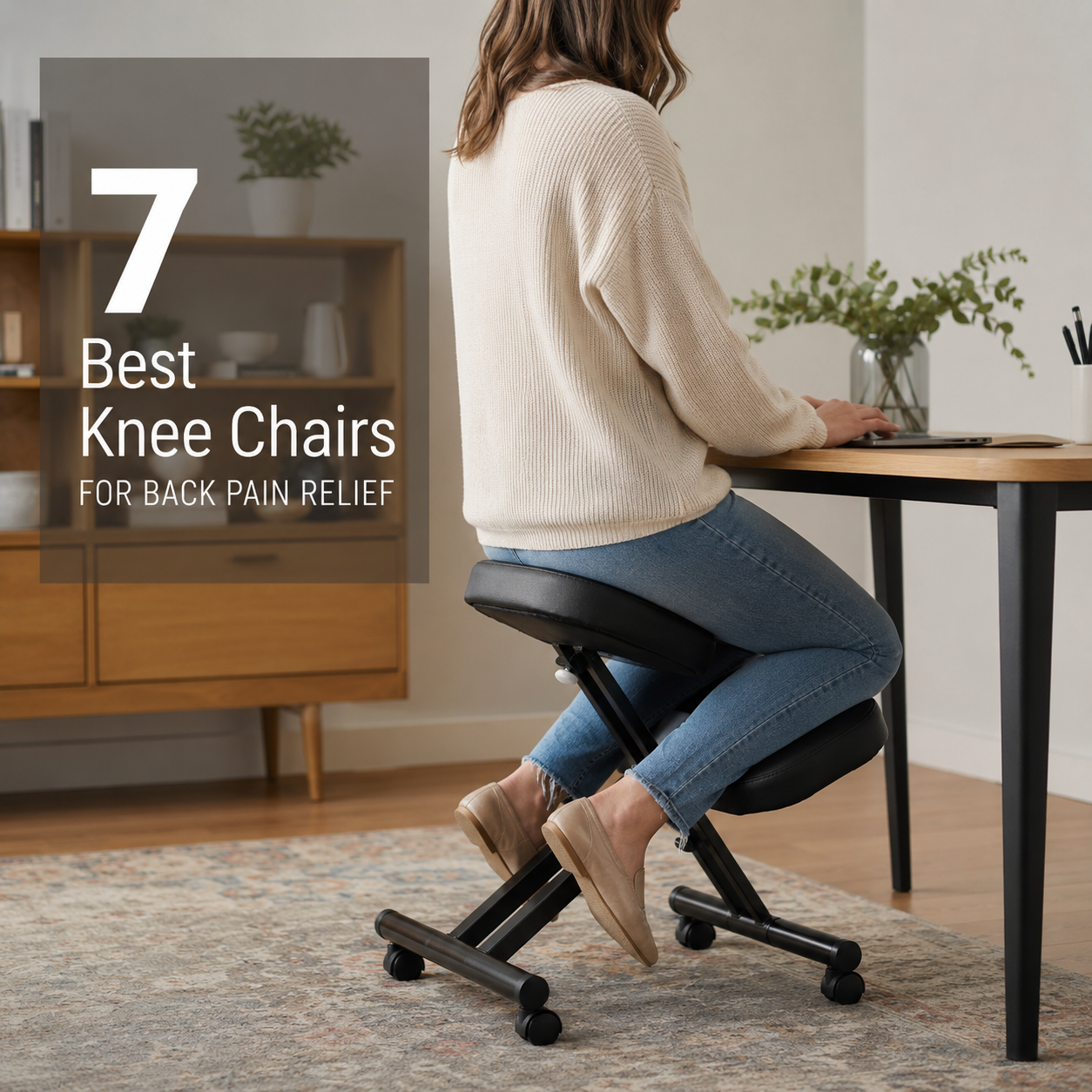
7 Best Knee Chairs for Back Pain Relief (Tested and Reviewed)
Best Knee Chairs and the Benefits
If your back aches by 3 p.m. and your standard office chair feels like it’s fighting your posture, a knee chair (also called a kneeling chair) might be the fix you haven’t tried yet. These ergonomic seats have been quietly gaining fans among remote workers, chiropractors, and posture-conscious professionals – and for good reason.
In this guide, we’ll break down exactly how knee chairs work, the science-backed benefits, what to look for before buying, and the best knee chairs on the market across different budgets and needs.
Best Knee Chairs at a Glance
| Chair | Best For | Frame/Base | Adjustability | Weight Capacity | Price Range |
|---|---|---|---|---|---|
| Varier Variable Balans | Best Overall | Sled base (rocking) | No height adjustment; optional backrest | ~250 lbs | $$$ |
| Varier Thatsit Balans | Best Premium | Sled base (rocking) | Adjustable backrest + knee pads | ~250 lbs | $$$$ |
| Sleekform Austin | Best Value | Sled base (rocking) | Height adjustable | ~300 lbs | $$ |
| DRAGONN by VIVO | Best Budget | Rigid metal frame | Height adjustable (21–28″) | ~250 lbs | $ |
| AtHope Cross-Legged Chair | Best Versatility | 5-star swivel base | Height + footrest adjustable | ~300 lbs | $$ |
| Giantex Kneeling Chair | Best Heavy-Duty | Solid wood frame | Height adjustable | 330 lbs | $$ |
| NYPOT Kneeling Chair | Best Warranty | Wood rocking base | Adjustable pads | ~300 lbs | $$ |
*Price key: $ = under 100 · $ = 100–200 · $ $ = 200–350 · $ $$ = $350+*
What Is a Knee Chair?
A knee chair is a backless (or minimally backed) seat that splits your body weight between your seat bones and a padded knee rest positioned below and in front of you. Instead of sitting at the traditional 90-degree hip angle, you sit in a forward-tilted position that opens your hip angle to roughly 110 degrees.
This design was originally developed in the late 1970s by Norwegian furniture designer Peter Opsvik, and the concept has evolved into dozens of variations – from rigid metal-frame models under $100 to premium Scandinavian sled-base chairs that cost several hundred dollars.
The Real Benefits of Knee Chairs
1. Better Spinal Alignment
A standard office chair holds your lower back at roughly a 7-degree angle, which – combined with leaning forward at a keyboard – is a common contributor to slouching and lower back strain. Kneeling chairs instead align the lumbar spine closer to a 20-degree angle, which helps engage postural stabilizer muscles and can ease lower back pain, according to ergonomics experts and published research.
2. Reduced Pressure on the Hips and Spine
By opening the hip angle to around 110 degrees, knee chairs relieve pressure on the spine and help keep the back, neck, and shoulders in better alignment, which encourages core engagement and helps prevent back strain over long sitting sessions.
3. Encourages “Active Sitting”
Kneeling chairs support what’s known as active or dynamic sitting – a way of sitting that mimics the small postural adjustments your body makes while standing or walking, activating the paraspinal muscles that keep you upright. This subtle engagement can help prevent the stiffness that builds up during hours of static sitting.
4. Reduced Knee and Lower-Back Strain for Desk Workers
For people who deal with knee discomfort from being wedged under a desk in a standard chair, a well-cushioned knee chair redistributes weight so the knees aren’t bearing constant pressure. Reviewers consistently note noticeable relief from back and joint discomfort within the first few days of switching.
5. A Genuine Alternative When You Need Variety
Ergonomists generally don’t recommend using a knee chair as your only seat all day, every day. Instead, most experts suggest treating it as one option in a rotation – alternating between a knee chair, a standard ergonomic chair, and standing throughout the day for the best results.
What to Look for Before Buying a Knee Chair
Adjustability. The best models let you adjust seat height and the angle between the seat and knee pad, since your ideal position depends on your body proportions and desk height.
Cushion quality. High-density foam holds its shape far longer than cheaper foam, which compresses quickly. Look for at least 3 inches of padding, and breathable fabric (mesh or linen) over vinyl if you run warm.
Frame type. Rigid X-frame and 5-star base designs are the most affordable and portable, but they limit body movement. Sled-based designs (like the classic Balans-style chairs) flex slightly, allowing a gentle rocking motion that’s more comfortable for extended daily use.
Weight capacity. This varies widely between models – from around 250 lbs on basic models up to 440 lbs on heavy-duty designs, so check this before buying if it matters to you.
Portability. If you plan to move the chair between rooms or share a desk, look for a lightweight frame and quality casters.
Best Knee Chairs of 2026
1. Best Overall: Varier Variable Balans
The original kneeling chair, in continuous production since 1979, is still the benchmark the entire category is measured against. Its flexible beech plywood sled base allows a genuine rocking range of motion that rigid-frame competitors can’t match, and the padding holds up well over time without bottoming out. It lacks a backrest by default (available as an add-on) and doesn’t offer height adjustment, but the build quality and comfort at this price point are hard to beat.
Best for: Anyone who wants the true “active sitting” experience and plans to use the chair for hours at a time.
2. Best Premium Pick: Varier Thatsit Balans
Varier’s higher-end model Thatsit Balans adds an adjustable backrest and independently adjustable knee pads on top of the same flexible sled-base design. It’s a genuine investment, but for people who sit in a knee chair daily, the extra adjustability and comfort can be worth the premium.
Best for: Daily, all-day users who want the most refined version of the sled-base design.
3. Best Value: Sleekform Austin
Sleekform’s kneeling chairs consistently rank near the top of independent reviews for offering much of the comfort of premium brands – memory foam padding, a sturdy wood frame, and a rocking motion – at a noticeably lower price. Assembly is straightforward, and the roughly 4-inch cushion holds up well over extended sessions.
Best for: Buyers who want a rocking, high-comfort chair without paying Varier-level prices.
4. Best Budget Option: DRAGONN by VIVO Ergonomic Kneeling Chair
The DRAGONN by VIVO is one of the most popular kneeling chairs under $150, with a sturdy metal frame, height adjustment from 21–28 inches, and roughly 3 inches of cushioned padding on both the seat and knee pad. It won’t offer the rocking motion of sled-based designs, but for a first kneeling chair or occasional use, it’s a reliable, affordable entry point.
Best for: First-time buyers testing whether a kneeling chair works for them.
5. Best for Versatility: AtHope Cross-Legged Office Chair
This AtHope Office Chair model stands out for letting you sit cross-legged, kneel, squat, or shift side to side, with a wide seat and a 360-degree swivel footrest. For people who fidget or need to change position frequently to stay focused, this flexibility is a genuine advantage over fixed kneeling designs.
Best for: People who struggle to stay in one position for long stretches.
6. Best Heavy-Duty Option: Giantex Kneeling Chair
The Giantex Keeling Chair with a 330-lb weight capacity – among the highest in the category – a solid wood frame, and a U-shaped knee support that distributes weight evenly, this is the model to check first if you’ve struggled to find a kneeling chair that comfortably fits a larger frame.
Best for: Users who need a higher weight capacity than most kneeling chairs offer.
7. Best for Warranty Confidence: NYPOT Kneeling Chair
The NYPOT Kneeling Chair is a wood-frame rocking chair with a 5-year warranty – well beyond the 1-year (or no) warranty offered by most chairs in this category – plus adjustable pads and a gentle rocking base. It offers much of the wood-frame, active-sitting feel of premium brands at a mid-range price.
Best for: Buyers who want warranty peace of mind on a mid-priced chair.
Common Mistakes to Avoid
- Expecting instant comfort. Your first week in a knee chair will feel different – you’re activating core and upper-back muscles that don’t do much work in a traditional chair. This adjustment period is normal.
- Using it as your only chair, all day. Most ergonomists recommend rotating between a knee chair, a standard chair, and standing rather than committing to one position for eight hours straight.
- Skipping the adjustability check. A knee chair that doesn’t match your leg length and desk height can create new discomfort rather than relieving it – always check seat height range and knee pad angle before buying.
- Ignoring weight capacity. Buying a chair rated below your body weight is one of the most common return reasons cited in reviews.
Frequently Asked Questions
Are knee chairs actually good for your back?
For many people, yes – the open hip angle and improved spinal alignment can meaningfully reduce lower back pressure. That said, they’re not a universal fix, and some users find the kneeling posture uncomfortable, particularly on the shins and knees if the padding is thin.
Can a knee chair help with knee pain specifically?
It can, since it redistributes weight away from constant pressure points. However, if you have existing knee issues, it’s worth checking with a doctor or physical therapist before committing to daily use.
How long should you sit in a knee chair each day?
Most experts suggest starting with short sessions (20–30 minutes) and building up gradually, then rotating with a standard chair rather than using a knee chair for a full workday right away.
Do knee chairs work for tall or larger users?
Yes, but check the specs carefully – height adjustment range and weight capacity vary significantly between models, from around 250 lbs on basic chairs up to 440 lbs on heavy-duty designs.
Final Thoughts
A knee chair isn’t a magic fix for back pain, but the ergonomic case behind it is genuinely solid: better spinal alignment, an open hip angle, and more engaged postural muscles than a standard office chair provides. Whether you go with the classic Varier Balans, a value-focused Sleekform, or a budget-friendly Dragonn, the key is choosing a model with the right adjustability and cushioning for your body – and easing in gradually rather than committing to it all day one.
Disclosure: As an Amazon Associate, we earn from qualifying purchases. If you buy through our links, we may earn a commission at no extra cost to you.